Monday, April 30, 2012

Sharing Cookies (Division by Grouping)


My son’s teacher sent out an email to parents that kids were struggling with dividing numbers equally on a recent math assessment. A little at-home practice was just what my son needed!

Forever ago, a blog follower recommended Pat Hutchins’ book The Doorbell Rang. Let’s just say, I am so glad she did! It was the perfect inspiration for this activity.


In Hutchins’ story, two children end up sharing a plate of 12 cookies with groups of children that continually ring the doorbell. Each time more kids come over, the plate of cookies is divided into equal parts to share with all the friends.

I printed a graphic of 12 oreo cookies to go along with the story. Download them here.
I put them on a platter and asked my son to count them. Then we read the first few pages of the book. When Sam and Victoria split the cookies among themselves, I wrote on a small whiteboard:
My son took the oreos and split them, placing six on the disposable plates I gave him. Then we turned the page to see that he had, in fact, divided the cookies right. (YAHOO!) When Hannah and Tom come over, the cookies must be divided up among four kids. I wrote on the whiteboard:
He split the cookies evenly and figured out 12 cookies shared by four children, meant that each would eat 3.


The story continued like this until each child at the house only gets 1 cookie. When it was done we tried a few more division problems with the cookies (12 divided by 3, 10 divided by 5, 10 divided by 2, and 9 divided by 3).

Then I put the cookies away and told him he’d have to figure out the problems without using the cookies I’d made for him. This was no easy task. I asked him how many cookies 4 children would get if the tray had 20 cookies. To help him, I wrote "1, 2, 3, and 4" on the whiteboard and had him draw cookies underneath each until all 20 cookies were represented. Ah-ha! “The answer is 5, Mom!” he exclaimed excitedly.


Now I gave him a super challenge – 35 cookies divided among 5 children. Instead of drawing circles for cookies, he made tally marks.


“Seven, Mom. Seven cookies each!!!” he yelled. I was so proud of him … almost as proud as he was of himself!

Hard Battles

Wildwood Zoo-2008
This is a post I never imagined writing.

How fitting that this morning, the first sound I heard was that of a Mourning Dove. The sun is shining and the sky is clear, and it doesn't seem fair for the heaviness that I am carrying inside of me.

The young man in the photo at the left is the son of a good friend of mine. He took his own life this past weekend at age 19. (He is pictured with his sister on left and my daughter on right.) Right now, there are not enough words, nor enough tears to express the sadness and pain that his family and friends feel.

I have spent many hours and days with my friend & her kids. I helped them find and move into their house in NC. I love them like my own. Lawrence was a bright, energetic inquisitive boy who was growing into an  intelligent, caring young man. There were minor bumps in that road, like we all have had, but it seemed as if he was smoothing over the rough spots.

He practiced yoga & loved the Asian Culture, especially the idea of  Ninjas. He was very artistic, protective of his sister & always looking for ways to help people. He was a lover of science & nature, and spent his last moments alone in the peace & quiet of the woods that he loved so much. The news of his passing has come as a huge shock.

I remember one time, when the family first moved down south, where my friend and I saw this grotesque bug-like creature jumping across the floor.  We backed away, not knowing if it was going to sting or eat us, and Lawrence stepped into action, and instead of killing it, he trapped it and proceeded to study it and learn about it. Then he set it free. To his credit, I now know more about Camel Crickets than the average Pennsylvanian.

There is a saying that goes: "Be kinder than necessary; for everyone is fighting a hard battle". I think we are all fighting our own personal battles. Some of us fight on the outside in obvious ways, and others are fighting on the inside, silently & alone, and don't know that there are allies to stand next to them, and behind them to help them win those battles.

We may never know why Lawrence made this choice, but we do know that many other teens also feel that there is no other option. My only hope is that we can become better allies-better friends to each other & prevent this kind of a tragedy from happening to another bright young soul.

Today, I'm asking that you choose to be kinder than necessary. Especially to yourself. Reach out to others in words and action, to help and be helped. No one has to ever feel or be alone.

Don't just fight those battles, win them.


*If you have a resource link to share for families, Please Post it in the comments below. Include the city and state where located.


S.A.V.E -Suicide Prevention

Kids Health-Teen Suicide

American Academy of Child and Adolescent Psychiatry

The Darkness - Suicide Prevention


.

Friday, April 27, 2012

Spelling with LEGO Minifigures


My son has been begging me to create another LEGO activity. Since the last one (our Under Construction Greater Than/Less Than game) was way back in August, I couldn’t say no. With the end-of-the-week spelling test looming, I thought it would be a good time to practice.

To make our “I say it, you spell it” lesson more exciting, I grabbed the drawer from my son’s LEGO organizer with all the minifigures (aka “people parts”).

Empty egg carton and spelling list in hand, I wrote the letters of his first spelling word inside two strips of paper with six boxes in each strip. I scrambled the letters and added extra letters so each box was filled. Then I put one strip above the egg carton and one below. I added specific minifigure parts to the egg carton compartments that had the letters in his spelling word and then tossed extra parts into the empty compartments.

I made strips for eight words. Now it was time to test his spelling abilities. I told him the word and he wrote it down.


Then he looked for the letters on the strips and grabbed the corresponding LEGO minifigure piece from the egg carton.


Spelling Word: might

If he spelled the word right, he had the correct body parts to make a figure (e.g. he had the knight’s torso and knights pants, not two heads and a pair of pants).


When he was done with this word, I moved the carton out of his view, swapped the strips of paper, and reloaded the egg carton with new minifigure pieces.

This was tons of fun for my son, even though the week’s spelling words were easy for him (he even got the challenge word – frightening – spelled right; it was so many letters long, I had to have him make two figures for that one!).


When the activity was over, there was no grumbling that he still wanted more “playtime” with Mom. After all, he had nine minifigures beckoning!

A Matter of Trust

No parent should feel they have to send their kids to school with a wire on, because they are suspicious of classroom staff, but I understand why they do. Its a matter of trust.

I felt compelled to post this today, not because I want to shock and depress everyone, but because I want to educate and motivate.

You may have heard by now of the father in Cherry Hill, N.J. who sent his autistic son to school with a wire on, because he suspected his sudden violent behavior was due to something going on in the classroom. Well there was. He was being verbally abused and intimidated by his own teachers and assistants.

I started out as an assistant (para professional). I know how stressful it is, and yes, I have seen this kind of treatment of special needs students. Its sickening to me and the reason I decided to not go back into the public education setting when I moved to PA. I was lucky that my last teaching experience in NJ was a good one, but what this Cherry Hill family has experienced, makes me want to cry. What this teacher did, hurts every child & every parent, in addition to making every educator look bad.

Administrators: there is discussion about installing cameras in classrooms. Sure, go ahead, do that. But how about supporting and training the staff on an ongoing basis and not just hiring them, paying them $10/hr and then letting them figure the rest out themselves? They need support and training, so this doesn't happen at all.

Furthermore, how about releasing these teachers of their duties entirely instead of just shuffling them around & re-assigning them to other classrooms. We were outraged when we found out that Bishops re-assigned priests who abused children to other parishes-why should a teacher abusing a special needs child be treated any differently? Both behaviors place all children in danger and both need to be immediately suspended/ terminated until investigated. (NOTE: only one of these teachers was fired. The rest were re-assigned and are still working as of this date.)


Educators: Ignorance & lack of training doesn't excuse you from acting right. Ask questions and use your common sense. The internet is an unlimited source of information. So are the other professionals you work with. You are a team. Work together & look for other resources to educate yourself to do your job better. Take some pride in yourself and the work you do.

If you are a teacher, para-professional or other staff member, watch this video, listen to the recordings- and think about how you treat the kids you are around. Every second of the day, you have the power to either help them-or hurt them deeply, not just with your actions, but with your words. Don't abuse the responsibility or the trust you've been given. Your actions affect everyone involved.

We chose to work with children with disabilities. The child did not choose to have a disability. These students & families depend on us for guidance and protection. If you see abuse, verbal or otherwise, report it. We ALL are accountable for children's well being. Don't stand by silently and watch your co-workers treat any child like this.

I wish the Chaifetz family the very best.

Watch the video here:

Teacher Bullies Autistic Child


Contact: barbara@bodylogique.com

Wednesday, April 25, 2012

DIY Shuffleboard Showdown


My son and I went head to head for two games of Shuffleboard on our kitchen hardwood floor the other day. He obliterated me the first game, but I came back and won the second. Both of us were pleased!

Like most games, scorekeeping is required. Shuffleboard’s “10 OFF” box means that players won’t just have to add the points from each round, but they’ll have to subtract too! This was loads of fun and a subtle way to slip in some addition and subtraction practice.

I made the shuffleboard court with blue painters tape. 

The pucks (or biscuits) were large metal closet door pulls (they were being clearanced out at our local hardware store). To distinguish which pucks where whose, I cut some circles of craft foam and placed them inside the pulls, attaching them with a piece of double-sided tape.

Don’t want to buy your pucks? Start saving lids (e.g. spaghetti sauce jar lids, peanut butter jar lids, etc.). You just need six of the same size.
For our paddle, I used the swiffer mop. It worked like a charm.

I put a line on the floor five feet back from the point of the board for my son and I to stand behind. A homemade scorecard helped to keep track of the points. (Download it here.)


Rules of play (for our variation of Shuffleboard)
Play alternates between two players. Each player stands behind a line and pushes the puck with the swiffer toward the shuffleboard. If the puck is inside any part of the board’s triangle, points are earned.


If the puck lands at the end of the board in the “10 OFF” area, the player must subtract 10 points from their score. The opponent can knock a player’s puck off the board with their own.


The first player to get to 45 points is the winner! (The traditional game is played until 75 points are earned; the scorecard I made has lots of rounds to account for extended play.)

Tuesday, April 24, 2012

Say It Better

We take the ability to communicate for granted. Just open up your e-mail inbox and you will see loads of communications-some welcome, some unwelcome and most, redundant.

The part of yoga that the adults (and teens) like the most is the relaxation part-when everyone stops talking and just listens to their own bodies & what they are communicating to us.

Spoken language is developed through a specific sequence - first we listen (receptive language), then we imitate (expressive language), then we begin to innovate, and finally we invent. This process happens naturally when children and adults are having fun, playing and interacting.

In the early stages of this process, some children find it difficult to listen for very long. (This happens again during the teenage years!) For a toddler, spoken sounds are in general, not as engaging as pictures. A child's ability to focus for longer durations can be built up through visually  interactive games such as dancing, dress up, catch, yoga or hide and seek. 

Language is central to learning & the ability to use and understand language is essential for all children. Spoken language develops at an incredible rate,when children have opportunities for conversations with others - both adults and children. But what happens when a child has a sensory, cognitive or communication challenge?

Experts tell us that the first 6 months of a child's life are crucial to language development. The prevalence of speech disorders is about 8 to 9 percent by & the first grade, roughly 5 percent of children have noticeable speech disorders; the majority having no obvious or known cause. Speech & language delays are the most common developmental difficulty that children encounter. A study by a basic skills agency reported that, in the opinion of teachers, 50% of children start school lacking skills that are vital for a successful start to education. Early intervention specialists, preschool staff & peers & family members all play a vital role in encouraging communication development in children.

One of my parent & educator workshop topics puts focus on communication, particularly receptive language. (Expressive language can only develop and expand after receptive is mastered.) One of the techniques I use is to observe students for outward signs of stress. Doing this can help determine if the child is understanding or tuning out.

Once a child is stressed  for any internal or external reason, you will have difficulty communicating with him at all on any level. I further show parents and educators techniques and games that help a child self-regulate allowing for better readiness for longer listening & stronger receptive language skills.


Here's why we look for stress signals: When our brains are overloaded, stressed & confused, our bodies compensate for not being ready to listen/learn/think by using actions as aides to re-engage. Adults do this too. Its called fidgeting.

Chronic compensation will fatigue the body & inhibit any further listening/learning. This leaves muscle tension that acts as a trigger each time the student/ teacher is confronted with a similar situation So it is imperative to speak simply and clearly, recognize these outward signs of internal stress, give children frequent breaks & tools to self-regulate.


Outward signs of compensation, confusion & impending stress response are:
  • staring
  • locked knees/elbows/jaw
  • fidgeting
  • holding breath
  • disruptive behavior (talking, calling out, etc.)
  • agitation
  • closing eyes
  • physical ticks (knees, fingers or foot tapping, etc.)

A good rule to follow in general with all children while language is developing or when communicating with a child who has delays: say things better. Keep it simple. Use one word per year of age.  It seems obvious, but you would be surprised at how many overlook this simple technique.


Start by eliminating adjectives, adverbs and all variations of the word "try" from your vocabulary. (Such as the common uses of "No-try again..." In ABA drills.)


"Try" implies extra effort, that the child is "losing it" and can’t get it right. This creates over-focus and a child with language delays cannot move/process and think/process at the same time. The stress will over-excite & confuse the brain and cause it to shut down, therefore halting the ability to receptively understand.


Replacing this phrase with "do your best" implies ease, relaxed learning & "getting it". You have now empowered the student by eliminating judgement, expectation, competition or comparison to the last failure or success. You have now created engagement, and an atmosphere for listening-for the next instruction, for the "That was awesome!" or the "You did it!". You have created an opportunity for learning receptive language.


"Don't" is another word to eliminate. The brain cannot process it. "Don't Run/hit/bite" (or the variation "no running/hitting/biting" ) translates into: "Run/hit/bite". Its more constructive and clear to a child if you tell them what you WANT them to do, "Please Walk/keep yourself & friends safe" or "We are Walking/We keep ourselves & friends Safe".


As for demanding Eye Contact-use your best judgement! Ultimately we want the child to look at us when communicating. Keep in mind that if the child is engaged, they will naturally want to look at you. This should be spontaneous and when they are ready, they will. Avoid the temptation to use your hands to turn a child's face towards you-this discourages spontaneous communication & is intimidating to the child. When you get down on their level, and play, will you do far more to motivate eye contact than trying to force it before the child is ready.


To receive workshop information please email:


barbara@bodylogique.com


.


Monday, April 23, 2012

Dicey Fractions


What is it about rolling dice that kids love so much? I don’t know, but every dice roll activity I come up with my son loves. This dice roll was made to work on fractions, but incorporates so much more – counting, tallying, animals (i.e. mammals vs. non-mammals), and geometry (shape names, polygons, etc.)!

First we read Working with Fractions, a book by David A. Adler (who also wrote the wonderful book that taught my son all about roman numerals).


Then, I gave my son a fun die with six different colors, animals, and shapes. (I printed this on heavyweight cardstock, cut out, scored the lines with a straight edge and butter knife, folded, and glued the flaps.) 


With a special recording sheet in hand and the timer on our microwave set for 2 minutes, my son was ready to get rolling!

Download a PDF of the die and recording sheet I made here.

He rolled the dice for the entire time, making a tally mark in the boxes under the square that showed up on top of the dice with each roll. I reminded him “One, two, three, four, and five shuts the door” to help him organize his tallies in groups of five.


When the time was up, my son counted the tally marks in each box and added all of the numbers together (I helped). The total was the denominator (the bottom number) on the fraction answers at the bottom of the recording sheet.


To complete the fractions, he had to figure out the numerators (the top number). Several of the fractions required that he add number of rolls from different squares together.


This was good practice to understand what the numbers on a fraction represent and reminded my son about what makes an animal a mammal, which shapes are polygons, and the reinforced geometry vocabulary too!

Friday, April 20, 2012

Its Friday! In Case You Missed it-April 16-20


In Case You Missed it... Its Friday! and we are back as promised with the top article links for this past week.


For those of you new to my blog, each Friday, we feature the top articles (archived and new) that are relevant to those who work with children with social, sensory and learning challenges. The purpsoe of this weekly post is to expand and improve the scope of resources & information for families, educators & otehr professionals. We want to build connections with diverse resources to help each other stay informed in the most straightforward and entertaining way possible.

To read the original article, click on the title link. (A short description as a quote or excerpt taken right from the article appears under each link.) The source is listed under the article title. Please feel free to share, with the original links & authors referenced.

If you have an article link you would like to add, contact Barbara at the e-mail at the bottom of this post.

Guest post submissions are always welcome!

Please report any broken links to Barbara at the e-mail link below.

Have a Fantastic Weekend!

~Barbara

barbara@bodylogique.com


Affection Deficit: Dealing with Students who Hear a Different Drummer
(Edutopia)
I had assumed that my son's interests in science & electronics would make him a great student. I was wrong. Instead, school has been an ordeal. Why? Because Cole will tune out what doesn't interest him. He can get lost going from one simple task to another, and his imagination revs up without warning, taking him from spelling quiz to intergalactic mission in a matter of seconds...


Autism, Inflamation & Nutrition
(Psychology Today)
Autism. The reason no one has been able to find a specific pathological cause or cure is because it is multifactorial - it seems that a combination of genetic, environmental, neurological, and inflammatory factors contribute to the development of autism. Today I would like to focus specifically on the inflammation and other evidence of nutritional contributing factors...


 Healthy Ways to Show Feelings (A classroom activity Grades pre-k to 2nd grade)
(Teaching Tolerance)
Individuals of all ages can find it difficult to identify and express their feelings in a positive way. At the elementary level, many students need a springboard for discussion. This can help make students more open about their feelings.


Redefining 'Normal'
(Stuart Duncan, Autism from a Father's Point of View)
Normal… that peculiar notion of fitting in with those around us. Not with society… but with those around us. In highschool, some people felt it was normal to be with the cool kids, others with the nerds and so on. At work, for me, the designers tend to fit in with other designers more so than programmers and programmers tend to fit in with other programmers better than designers...


The 'Sun Stretch' for Kids!
(BodyLogique.com)
Yoga can be used to release frustrated pent-up energy, to calm and relax in the classroom (before a test) at home (before bedtime) or anytime & anywhere the need arises. It helps build physical strength, character and confidence & can be done indoors or outside. No special equipment is needed. Our "Pose & Postures"Page is a feature to acquaint you with some of the things we learn in a typical play group or class. Try the "Sun Stretch"...


Contact: barbara@bodylogique.com


Subscribe to S.M.Art Kids / Healthy Kids by Email

Pronoun Practice to the Moon and Back


Our Roy Orbison pronoun practice was great fun, but I could tell at the end my son was still a little foggy on how pronouns are used. This activity is meant to clear up the confusion.

It uses my son’s interest in space to excite him about learning pronouns!

First, we read the Grammar Tales book The Planet Without Pronouns by Justin McCory Martin. This book was EXACTLY what I needed to explain just how helpful and useful pronouns are.


The main character, Stanley, notices when talking to the residents of planet Krimular that they don’t use pronouns! He gives his buddy Zik a lesson explaining, “Pronouns are small words such as I, you, me, her, or him. … They are used in place of nouns to make sentences simpler. Think of them as ‘shortcut’ words.” Ah, yes, shortcut words, why hadn’t I thought to explain them that way? This was something my son could relate to!

When my son finished reading (He’s a level K reader so I helped him with some of the more challenging words), I gave him some folded practice cards and a “to the moon and back” scorecard.


His job was to pick a card, read the front, and either replace the highlighted word(s) or add the pronoun if it was absent.


Once he’d done this, he opened the flap on the card and if he got it right, he could move the rocket ship one line closer to the moon. When he got to the moon, he rotated the rocket ship around, kept practicing, and headed back to Earth
.

He loved this activity and wanted to continue practicing with the leftover cards once his space journey had ended. Success!


Directions to Make it Yourself
Download my PDF of the pronoun practice cards and “to the moon and back” scorecard. The pages in the file are ordered so you need to print page 1, flip it over and print page 2, and so on. Once printed on heavyweight cardstock, cut the cards, fold on the dotted line, and use a Exacto craft blade to cut the "V". Tuck the folded flap under the point on the V for each card.

To make the scorecard, cut out the rocket ship and tab. Use an Exacto craft blade to cut out the rectangle for your rocket ship slider. Then poke holes in the rocket ship and tab with a brad. Put the tab behind the “to the moon and back” scorecard lining up the whole you punched inside the open slit you cut out.


Put the brad in the rocket ship, place on top of the scorecard and thread it through the tab that’s behind the scorecard. Spread the brad apart tightly. Now you’re ready to blast off!

Wednesday, April 18, 2012

Making a Magic (Drinking Straw) Flute


Maybe my kids are weird but both of them love using drinking straws. So we had all the supplies we needed on hand for this little craft – nine straws and some clear tape.

When I told my son we were making a flute, he was super excited. His classroom teacher is getting married and has been sharing details of the ceremony. “You know what the only instrument being played at her wedding is, Mom?” my son asked. “The flute!”

Before we got crafty, we read a wonderful book. Kyra Teis has done a beautiful job adapting Mozart’s opera The Magic Flute into a children’s story. I bought this off Amazon and am SO glad I did.


Before we got into the story, we went through the cast of characters on the opening few pages. My son was already hooked – after all, there’s a wise and powerful sorcerer and an evil queen. Right there, he’d made up his mind that the story was going to be good. And it was! There’s a whimsy and wonder to the story that my son and I both loved. This book would be a winner for boys and girls alike.

With the book read, I asked my son to grab his ruler, scissors, nine straws, and some clear tape. It was time to make a pan flute! (I got the idea here.)

The first straw was set aside; it required no cutting. The second straw was lined up against the ruler and 2 centimeters were cut off the bottom. It was laid next to the uncut straw. The next straw, 2 more centimeter (i.e. 4 centimeters) was cut off. This process continued until 8 straws had been cut.


Now my son laid a long piece of clear tape sticky side up on the table and lined the straws up longest to shortest, with the tops of each even with one another. Then he wrapped the tape around them.


It was time to play our ‘magical’ flute! He blew over the tops of the straws! It truly DID seem like magic. The shortest straw made the highest note and the longest straw made the lowest.


After what seemed like an eternity, I was finally able to pull the flute away from my son long enough for him to write a little. (Click on the picture to download this PDF.)


I gave him some writing paper and asked him to draw a picture of himself playing the flute and tell me what he’d do if his flute truly WAS magical.


“I would play it for my brother to make him fall asleep,” he wrote. Since our youngest son has all but given up naps, I have to say, I think I’d play it if it could do that!


Before we both moved on to other activities, my son and I watched a little bit of a performance of The Magic Flute on YouTube. We had fun trying to figure out which singers were what cast members.

Monday, April 16, 2012

From The Archives

Well yesterday I realized that I didn't schedule a Friday "In Case You Missed It" Post! It was a such a  beautiful day, that I was out of my office most of it. I hope you were too.

Today I've selected a few of the most-viewed articles-and a few of my personal favorites- from my archives and linked them here. Enjoy & feel free to pass on to others the ones you find most useful.

"In Case You Missed It" will return on Friday in its regular spot.

Have a great week everyone!


~Barbara


Helping your Child Sleep Well
(January, 2012)
It is estimated that as many as 30% of all children may have a sleep disorder at some point during childhood. Sleep disorders can impact health, school performance, day to day activities & social-emotional adjustment. For this reason it is important for both parents and educators to understand these disruptions and simple ways to assist children to rest and sleep better...


The Connection Between Sensory Integration & Yoga
(July, 2009)
Yoga itself is a natural form of sensory integration and It can be adapted to a variety of ages, learning styles and environments. Yoga will assist in facilitating many of the same skills as conventional S.I. as all 5 senses are stimulated & integrated during a 30-45 minute yoga session...


 Breathe-Relax
(July, 2010)We don't usually associate stress with good news or happy events, but these can also create a stress response in the body. We need to take moments throughout our day to release this tension that builds up not just in our mind, but in our bodies too...


 Living in Color
(November, 2011)I love taking walks in the woods this time of year. The colors of the foliage is absolutely beautiful and so restorative & healing to me. My daughter often refers to this time of year as "Living in Color". Color is a form of non-verbal communication. Colors say something to us when we look at them. What colors make you feel happy? Agitated?


Peace Pose
(May, 2011)Today is a perfect day for soaking in the peacefulness of the sunshine, the clear blue sky & the cool breeze & watching Lauren, my daughter play with the neighbors grandchildren. They have had a very fun & busy morning; running barefoot in the grass, playing wiffle ball, catching butterflies, picking (and eating) strawberries from our garden, blowing dandelion seeds, playing with dolls and pretending to be astronauts...


Where Mind, Body & Technology Meet
(October, 2011)When I was a kid you couldn't pay me to stay inside. (Unless it was snowing out. I did not like the cold much and still don't.) 4 years ago, I moved myself and my daughter to an area with plenty of parks, rocks to climb, biking & hiking trails and lakes. I am surrounded by the beauty of the woods & 'out doors' is a large part of my life. But as much as I advocate movement, sensory integration and art & nature being vital for children to learn & thrive, I want to also acknowledge that there are many places where the mind, body & technology meet and can live in harmony...


Dragonflies
(May, 2010)

"The Dragonfly Story" has become a favorite for the students in my Adaptive Yoga class for many reasons. In the story, a little "water beetle" who lives in the bottom of the pond gets curious to see what is up at the top. The story continues as he journeys into the unfamiliar, seeing new creatures around the pond and meeting new friends.One reason this story is so loved (by children as well as adults)  is the many lessons contained within it...


Contact Barbara: barbara@bodylogique.com


Geometry Jump!


It’s time to move beyond squares, rectangles, and triangles. With my son toting home worksheets about polygons, I decided to create a fun activity to work on some of the harder shapes – parallelogram, octagon, hexagon, pentagon, and trapezoid.

I took inspiration from a game we played often when my son was younger: Cranium Hullabaloo. If you’ve played this before, you’ll see the similarities.


I made 15 cards with numbers on them (three of each of the five different shapes). I printed them on 15 pages of cardstock in five different colors. (Download them here. Don't forget to shuffle the colored papers before printing!) Then I made a wacky die with things like walk like a chicken, hop, and dance on it. I printed the die on heavyweight cardstock, cut everything out, and glued the die together. Click the picture below to download the die template.


When my son came home from school, we read Shapes in Transportation. This book was perfect to remind my son about the names of the shapes we’d be working with and showed just how common they are.


Having read the book, it was time to get moving. I had my son help me spread the shapes out all over the floor. Then I set the timer on our microwave for three minutes. I told my son that he needed to move to the shape, number, or color I called out as quickly as possible in the way the die dictated.

Ideas for call-outs:
Give an addition and subtraction problem equal to the number on the shape.
Ask that the child move to a particular shape (e.g. hexagon or trapezoid).
Tell him/her to find an odd (or even) number.
Pick one of the colors and call it out.
Instruct the child to move to a shape with a certain number of sides.

When the timer went off, I named one of the above again and if my son was standing on that particular color, shape, or number he was a winner. We played over and over!


Oh, my word, did he have fun!?! This was great math practice that had my son dancing, hopping, crawling, and “swimming” across our living room.

Friday, April 13, 2012

Recreational Activities that Prevent Summer Learning Loss

Summer Learning Loss is the regression and loss of motivation & skills seen in kids after the school year ends. Research has shown that summer learning loss occurs when children don't have access to camps, recreation and other summer activities.

During the school year, students learn at relatively similar rates. More than 1/2 of the achievement gaps that occur over summer break can be attributed to unequal access to educational (and fun) activities due to economics, disability or traveling distance.

To prevent summer learning loss, be sure to expose your children to a variety fun, interactive enrichment activities over the summer:


  • Play group activities
  • Nature center programs
  • Outdoor activities (plant a garden, go fishing, playground, etc.)
  • Library reading programs
  • Museums
  • Festivals
  • Sports (organized and neighborhood)
  • 4H / Scouts
  • Hobbies (science, art, music, yoga, dance, karate, cooking, model building, etc.)
  • Summer enrichment camps (see links below)

Below are links to directories of summer camps and activities in PA and beyond. You can read more about how to select a suitable summer camp:  Finding a Quality Camp Program for Your Child (From Blog Archives, July, 2010)


Camps:

Camppage.com  (US / Canada )

Kidscamps.com  (PA-Includes special needs camps)

Campresource.com  (PA)


Family Activities/Things to do:

Attractionsuptake.com  (2896 things for families to do in PA)

Playgroundbuzz.com  (Indoor & Outdoor activities for kids in PA)

4Kids in PA: (Things to see and do in PA)

Mama's Little Helper (Free and low cost events and activities in PA & NJ)


*Do you have a personal recommendation for a camp or activity? (Especially activities for children with special needs.) List it below in the comments box. Please include the city and state where the activity is located!


Contact Barbara at: barbara@bodylogique.com


Practicing Pronouns with Roy Orbison


As I was leaving my son’s classroom the other day after volunteering, I heard the teacher talking to the kids about pronouns. Uh oh, I thought. Knowing how the other parts of speech have been hard for my son to distinguish, I immediately began brainstorming … and Googling.

Using a song to identify pronouns wasn’t my idea; it originated from a Prentice Hall series of worksheets I found here.

When my son came home, we watched a Schoolhouse Rocks video to jog his memory about what words are pronouns and when/how they’re used.


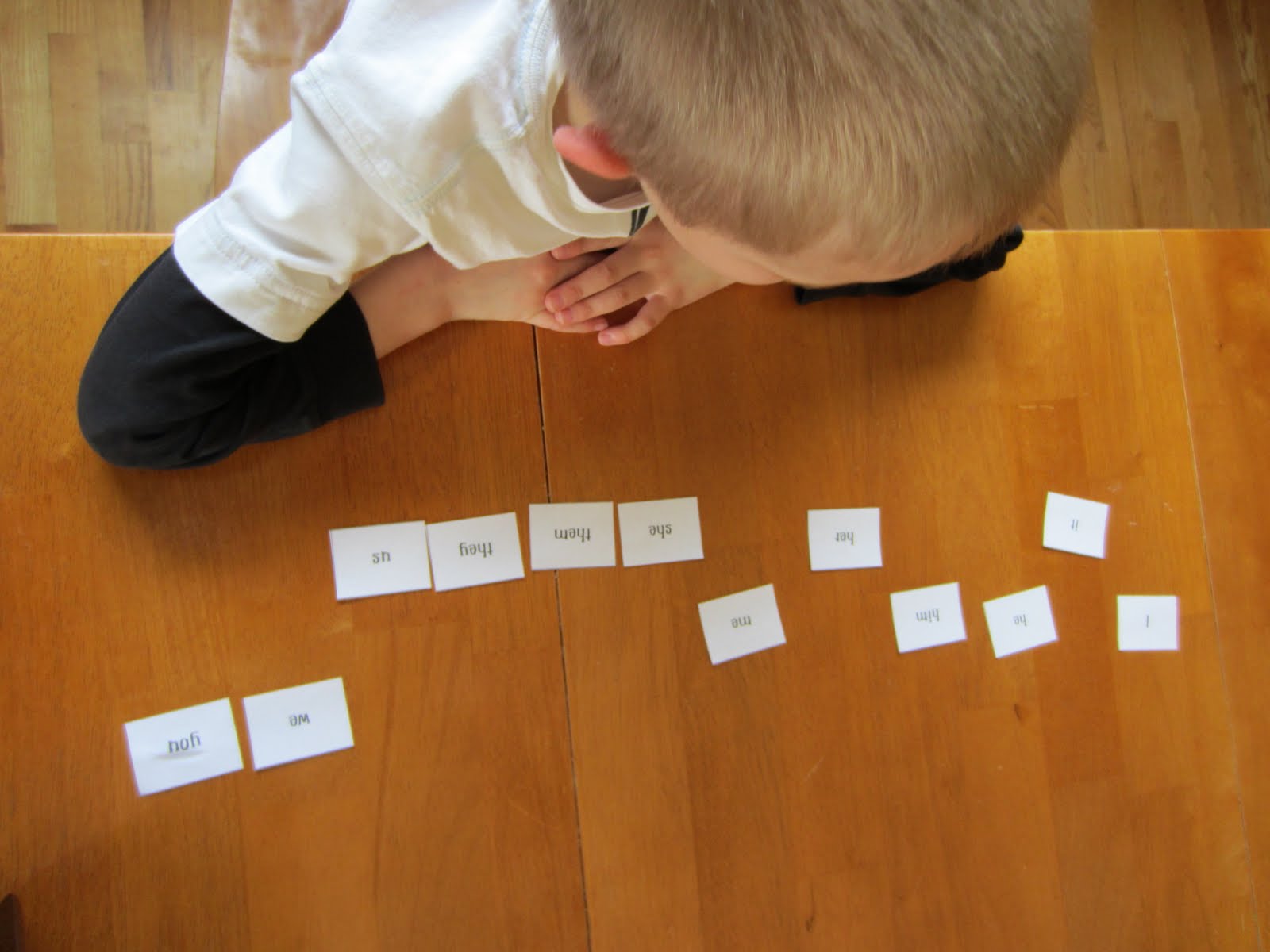
Then I gave him some small pronoun cards, which he put in alphabetical order.


Now I played the Roy Orbison song “Running Scared.” (I found it on YouTube. He didn’t watch, but rather just listened.)


It was my son’s job to pull out the cards with pronouns he heard in the song. He listened twice to be sure he’d found them all.


Then I gave him the lyrics I’d typed up. He circled every occurrence of the pronouns in the song.


Lastly, he graphed the pronouns to see which Orbison sang the most. My son LOVES graphing and always treats it like a contest to see which word, number, or object will win. It was a tie!


Download a PDF of the pronoun cards and graph here. Click on the lyrics to download them.